Aston Villa 2025-26 Full Squad, Caption, Coach, Kit, History and Stadium

Aston Villa Football Club is starting the 2025-26 season with fresh hope and big goals. The team from Birmingham is building on recent success under manager Unai Emery. Their strong performances in the Premier League have made them regular contenders in European competitions. The club is getting ready for another exciting season with smart player signings and team improvements.
The 2025-26 Aston Villa squad includes both experienced players and young talents. Fans are excited to see how the team grows with Emery’s tactics. The club is also focused on more than just players — they are working on better facilities and creating a stronger connection with their supporters.
Team Profile summary
| Team | Aston Villa Football Club |
| Nickname(s) | Villans, The Villa, The Lions, The Claret & Blue Army |
| Home Stadium | Villa Park |
| Stadium Capacity | 42,682 |
| Location | Birmingham |
| Founded | 1874 |
| Website | http://www.avfc.co.uk/ |
| League | 2025–26 Premier League |
| Manager | Steven Gerrard |
Aston Villa 2025-26 Squad?
Aston Villa’s 2025-26 team is strong and balanced, ready to play in the Premier League, UEFA Europa League, FA Cup, and EFL Cup. The table below shows some important players and their positions.
| # | Player | Position | Age | Nationality | Contract Ends | Market Value |
|---|---|---|---|---|---|---|
| 23 | Emiliano Martínez | Goalkeeper | 32 | Argentina / Spain | Jun 30, 2029 | €20.00m |
| – | Marco Bizot | Goalkeeper | 34 | Netherlands | – | €3.00m |
| 18 | Joe Gauci | Goalkeeper | 25 | Australia / New Zealand | Jun 30, 2028 | €1.50m |
| 42 | Filip Marschall | Goalkeeper | 22 | England / Poland | – | €800k |
| 4 | Ezri Konsa | Centre-Back | 27 | England / DR Congo | Jun 30, 2028 | €35.00m |
| 14 | Pau Torres | Centre-Back | 28 | Spain | Jun 30, 2028 | €32.00m |
| – | Yasin Özcan | Centre-Back | 19 | Türkiye | Jun 30, 2029 | €7.50m |
| 5 | Tyrone Mings | Centre-Back | 32 | England | Jun 30, 2027 | €5.00m |
| 22 | Ian Maatsen | Left-Back | 23 | Netherlands / Suriname | Jun 30, 2030 | €28.00m |
| 12 | Lucas Digne | Left-Back | 32 | France | Jun 30, 2026 | €10.00m |
| 15 | Álex Moreno | Left-Back | 32 | Spain | Jun 30, 2026 | €7.00m |
| 2 | Matty Cash | Right-Back | 27 | Poland / England | Jun 30, 2027 | €25.00m |
| 16 | Andrés García | Right-Back | 22 | Spain | – | €7.00m |
| 24 | Amadou Onana | Defensive Midfield | 23 | Belgium / Senegal | Jun 30, 2029 | €50.00m |
| 44 | Boubacar Kamara | Defensive Midfield | 25 | France / Senegal | Jun 30, 2027 | €40.00m |
| 26 | Lamare Bogarde | Defensive Midfield | 21 | Netherlands / Suriname | – | €6.00m |
| 32 | Leander Dendoncker | Defensive Midfield | 30 | Belgium | Jun 30, 2026 | €4.50m |
| 8 | Youri Tielemans | Central Midfield | 28 | Belgium / DR Congo | Jun 30, 2027 | €38.00m |
| 7 | John McGinn | Central Midfield | 30 | Scotland | Jun 30, 2027 | €16.00m |
| 6 | Ross Barkley | Central Midfield | 31 | England | Jun 30, 2026 | €6.00m |
| 41 | Jacob Ramsey | Left Midfield | 24 | England | Jun 30, 2027 | €32.00m |
| 27 | Morgan Rogers | Attacking Midfield | 22 | England | Jun 30, 2030 | €55.00m |
| 10 | Emiliano Buendía | Attacking Midfield | 28 | Argentina / Spain | Jun 30, 2027 | €15.00m |
| – | Samuel Iling-Junior | Left Winger | 21 | England / DR Congo | – | €10.00m |
| – | Lewis Dobbin | Left Winger | 22 | England | – | €2.50m |
| 31 | Leon Bailey | Right Winger | 27 | Jamaica | Jun 30, 2027 | €28.00m |
| 17 | Donyell Malen | Right Winger | 26 | Netherlands / Suriname | – | €25.00m |
| 11 | Ollie Watkins | Centre-Forward | 29 | England | Jun 30, 2028 | €40.00m |
Aston Villa’s Captain: John McGinn’s Leadership
John McGinn, a Scottish player, continues as Aston Villa’s captain for the 2025–26 season. Since joining the club in 2018, he has shown strong leadership through his hard work, energy, and dedication. He plays an important role in bringing together a team that mixes young talent and experienced players. Off the field, McGinn helps create team spirit and supports rising stars like Jacob Ramsey. His control in midfield and passion for the club make him a fan favorite and a key part of the team.
The Coach: Unai Emery’s Smart Tactics
Unai Emery is still leading Aston Villa into their seventh straight season in the Premier League. Known for his smart tactics, Emery has turned Villa into a strong and confident team since arriving in 2022. He focuses on keeping possession, pressing high, and playing with fluid movement—especially helpful in European matches. Emery’s past success in the UEFA Europa League, where he won four times, makes him the perfect coach for this season. His new contract shows his long-term plans with the club, and fans are hopeful that trophies are on the way.
Success and Goals
Under Emery, Aston Villa has improved a lot. He changes his tactics depending on the opponent, which has helped the team win important matches. Fans are excited and hope the team will win trophies in England and do well in Europe. Emery’s past success in the Europa League gives hope that Villa will have a great run in Europe this season.
Aston Villa 2025-26 Kit
Aston Villa’s new kits for the 2025–26 season are made by Adidas and combine the club’s proud history with fresh, modern designs. These bold, heritage-inspired shirts highlight Villa’s new status as an elite Adidas team and have quickly caught the attention of fans.
Home Kit: A Tribute to the Holte End
The home kit honors the famous Holte End at Villa Park. It has a burgundy base with blue and gold details, including a special gold pattern on the sleeve cuffs inspired by the stand’s architecture. The kit comes with white shorts and light blue socks featuring a gold ‘AV’ logo. It was released on July 17, 2025.
Away Kit: Inspired by the Bullring
The away kit was launched on May 22, 2025 and features a stylish black design with soft greyish-blue accents. The large circular sleeve patterns are based on Birmingham’s famous Bullring building. The Adidas and Betano logos appear in silver-grey for a clean, modern finish.
Third Kit: A Touch of Stained Glass
Set to release in August 2025, the third kit has an off-white base with claret and sky blue details. Its unique splatter pattern is inspired by stained glass, showing off Birmingham’s rich culture. As part of Adidas’ elite collection, this kit includes the prestigious Trefoil logo.
Kit Overview
| Kit Type | Colors | Design Inspiration | Release Date |
|---|---|---|---|
| Home | Burgundy, Blue, Gold | Holte End | July 17, 2025 |
| Away | Black, Greyish-Blue | Bullring | May 22, 2025 |
| Third | Off-White, Claret, Sky Blue | Stained Glass | August 2025 |
These kits perfectly mix Villa’s traditions with modern style, making them popular with fans and collectors alike.
Here is Aston Villa Kit 2025-26, Home, Away, and Third Jersey by Castore.
Aston Villa History
Aston Villa Football Club was founded in 1874 by members of the Villa Cross Wesleyan Chapel cricket team who were looking for something to keep them busy during the winter. The four founders were Jack Hughes, Frederick Matthews, Walter Price, and William Scattergood. Aston Villa’s first game was against local rugby team Aston Brook St Mary. As a condition of the match, the Villa team had to agree to play the first half with rugby rules and the second with football rules. The game ended in a goalless draw in the first half, but Jack Hughes scored a goal in the second, securing Villa’s victory in their first game. After moving to Wellington Road in 1876, they established themselves as one of the best teams in the Midlands, and in 1880 they won their first title, the Birmingham Senior Cup, with Scotsman George Ramsay as captain.
In 1884, former captain George Ramsey becomes club secretary. This role, at the time, performed activities today carried out by managers, such as being responsible for the team, as well as for recruiting and transferring players. In the 1886/1887 season, the club won its first FA Cup, captained by Archie Hunter, who became one of the club’s biggest idols. Villa defeated rivals West Bromwich 2-0 in the final held at The Oval. Until 1885, football was amateur. He turned professional in 1885 when the FA legalized professional football but with a national salary cap. However, Aston Villa’s Scottish director William McGregor was frustrated to see his team’s games canceled and matches with the little audience. He saw that for people to be interested in the sport, top teams would need to play each other in a championship, just as American baseball teams did. McGregor wrote to England’s top clubs proposing the formation of a league.
As a result, the Football League was founded in 1888 with Aston Villa as one of the twelve founding clubs and their first game in the competition was against Wolverhampton Wanderers, which ended in a 1-1 draw. end of the first season. It didn’t take long for Villa to lift their first League trophy, and this was achieved in 1894. The club became the most successful of the Victorian era, winning four more league championship titles (1896, 1897, 1899, and 1900) and two more FA Cups (1895 and 1897). In 1897, the year Villa won the double, they moved into their current home, the Aston Lower Grounds, better known as Villa Park.
1900 to 1960
Aston Villa started the 20th century as champions, but the difference that distinguished them from their competitors was diminishing. Football in England was becoming more competitive, with more teams being formed. Aston Villa won the 1905 English Cup, while in the 1909-1910 season they were English champions after eleven years, in which they beat Manchester United 7-1. The following season, Villa finished sixth, but in 1913, won the FA Cup.
After winning their sixth FA Cup in 1920, their last title with George Ramsey as secretary, who eventually left in 1926 after 42 years at the club, Aston Villa went into a decline that led to them being relegated for the first time, dropping to the second division in 1936. This was largely the result of poor defensive performance: 110 goals in 42 games, 7 of them coming from Ted Drake in the famous 7-1 defeat by Arsenal at Villa Park.
During World War II, Aston Villa and every club in England lost seven seasons, and many football careers had been cut short as a result of the conflicts. After the war, the team was rebuilt under the guidance of former player Alex Massie for the remainder of the 1940s. After 37 years without titles, in the 1956-57 season, another ex-Villa player Eric Houghton led the club. to a great achievement by winning the FA Cup in a final against Manchester United. Although the team struggled in the league, they were relegated two seasons later. However, under Joe Mercer Villa returned to the top in 1960 as second division champions. This season, the club became the first team to win the League Cup.
1960 to 1982
Mercer’s forced departure in 1964 marked a period of profound upheaval. Suddenly, one of England’s most successful clubs was struggling to keep pace with the changes in modern football and in 1967, under manager Dick Taylor, the team was relegated again. The following season they finished sixteenth in the Second Division table, and fans asked the board to resign. Initially, the board decided to fire Cummings (the manager hired to replace Taylor), but it was only a matter of weeks before the entire board resigned due to pressure from fans.
After much speculation, control of the club was purchased by London financier Pat Matthews, who also brought in Doug Ellis as president. The new owner could not stop the decline of their newly acquired club, so for the first time in their history, Villa reached the Third Division in the 1969-1970 season. However, Aston gradually began to recover under the management of former club captain Vic Crowe. In the 1971-1972 season, he returned to the second division as a champion of the third, with a record of seventy points.
In 1974, Ron Saunders took over the direction of the team, proving their effectiveness by winning the League Cup the following season, and in 1975 by taking them back to the top flight. With the team back in the elite, Saunders continued to shape a winning team. This culminated in their winning their seventh league title in 1981, after a 70-year fast. Despite this hegemony, and to the surprise of fans, Saunders is removed from office midway through the 1981-1982 season after an argument with the club president, leaving Aston in the quarter-finals of the European Cup.
1982 to 2001
He was replaced by his assistant Tony Barton, who guided the club to a 1-0 win over Bayern Munich in the European Cup final in Rotterdam, with a goal from Peter Withe. The following season he was champion of the European Supercup, beating Barcelona. Even though this was one of the most successful periods in the club’s history, Aston Villa was relegated a few years later, in 1987. The following year they ended up rising under the command of Graham Taylor, who also reached the runner-up in the First Division in the 1989-1989 season. nineteen ninety.
In 1992, Aston Villa was one of the founding members of the Premier League and ended the competition’s inaugural season as runners-up, second only to Manchester United. For the rest of the nineties, however, Villa had three different managers and their league positions were inconsistent, despite winning two League Cups and regularly reaching UEFA Cup qualification. In 2000, they reached the FA Cup Final but ended up losing to Chelsea 1-0, held at the former Wembley Stadium. The club was one of the three champions of the 2001 UEFA Intertoto Cup as they beat Switzerland‘s Basel 5–2 on aggregate.
2007 to 2016
In the following seasons, the club alternated its results and coaches, finishing in middle positions in the table, but stabilizing in the first division. In 2006, after 23 years as chairman and largest single shareholder (approximately 38%), Ellis finally decided to sell his stake in Aston Villa due to health issues. After much speculation, it was announced that the club was being bought by American businessman Randy Lerner, who owns an NFL club, Cleveland Browns.
The arrival of a new owner and manager Martin O’Neill marked the beginning of a period of major changes that took place throughout the club, including a new crest, a new sponsor, and team changes in the summer of 2007 and performing well in the Premier League. League, having reached the sixth position in three consecutive seasons (2007-08, 2008-09, and 2009-10). The first final of the Lerner Era came in 2010 when Villa was beaten 2-1 in the League Cup. Villa made a second trip from Wembley but lost 3-0 to Chelsea in the FA Cup semi-final. Just five days before the opening day of the 2010-2011 season, O’Neill resigned.
The B team manager took over the club before Gérard Houllier was hired in September 2010. Houllier stepped down on 1 June 2011, and was replaced by Birmingham’s Alex McLeish despite numerous fan protests against his appointment. . This was the first time that a manager had transferred directly from Birmingham to Villa. McLeish only spent eleven months in the job, and his contract ended at the end of the 2011-2012 season, in which Villa was only 16th, just two places above the relegation zone. He was replaced by then Norwich City manager Paul Lambert. The club was put up for sale in 2014.
In February 2015, Lambert was sacked after the team had scored just twelve goals in 25 games. Tim Sherwood was his successor and saved the team from relegation, as well as reaching the FA Cup final, having lost to Arsenal 3-0. Sherwood was eventually sacked the following season and was replaced by Rémi Garde, who was later replaced by Roberto Di Matteo when, in the 2015/16 season, Aston Villa dropped down a division in English football, being last placed. Di Matteo left the club after a poor start to the second division, being replaced on an interim basis by Steve Clarke.
Aston Villa had to spend 3 seasons in the EFL Championship, the English second division.
Season 2016-17
His first season in the EFL Championship, 2016-17, was full of ups and downs, the club must settle for the 13th position with 62 points, and 18 points from 6th placed Fulham, which is the position that puts the possibility of promotion to Premier League.
His second season in the EFL Championship, 2017-18, was already much better than the first, ranking 4th with 83 points, thus qualifying for the Premier League Promotion Play-Offs. In the semi-final Aston Villa played against Middlesbrough, winning the first game 1-0 at Riverside Stadium, home of the opposing team with a goal by Mile Jedinak. In the second game, Aston Villa only held the advantage at Villa Park, drawing 0-0 and advancing to the final. The final was played at Wembley against Fulham, with Aston Villa losing 1-0.
In their third season in the EFL Championship, in 2018-19, Aston Villa performed worse on points than the previous season, finishing in 5th place with 76 points, qualifying again for the play-offs. In the semi-final, Aston Villa played against West Bromwich when in the first game at Villa Park Aston Villa won by a score of 2-1. The second game at The Hawthorns was exciting, with West Bromwich winning 1-0 when in the 80th minute a player from the opposing team was sent off, however, the match went to penalties with Aston Villa winning 4-3 and so on. getting a spot in the play-off final, qualified to face the Derby County team.
Season 2019–20
In the play-off final played at Wembley, the Birmingham team defeated Derby County 2–1 with goals from El-Ghazi and McGinn, earning their spot in the 2019–20 Premier League after 3 seasons.
2021-22 season
On the eve of Villa’s Premier League return, NSWE purchased minority share ownership of the Recon Group, meaning that Xia no longer had any stake in the club. In Villa’s first season in the Premier League, the team battled relegation for most of the season but managed to avoid it with a 17th-place finish, staying up until the last day. In Villa’s second season in the Premier League, Smith oversaw an 11th-place finish but was unable to persuade star player and captain Jack Grealish to remain at the club when Manchester City’s £100m British offer triggered his release clause. Following a poor start to the 2021-22 season, which saw seven defeats in the club’s first 11 games, Dean Smith was sacked.
Aston Villa appointed former England captain Steven Gerrard as head coach on November 11, 2021.
Aston Villa 2025-26 Home Stadium
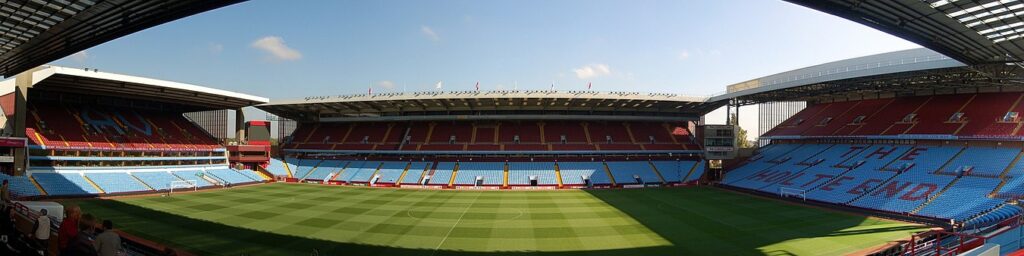
Aston Villa’s home ground is Villa Park, a UEFA Category 3 stadium (out of a maximum of 4), which opened on 17 April 1897 in a friendly against Blackburn Rovers. Previously, the team played at Aston Park (1874–1876) and Wellington Road (1876–1897). The stadium, which has gone through several phases of renovation and development throughout its history, is the largest in the Midlands and the eighth largest in England.
It has hosted 16 England matches, the first in 1899 and the most recent in 2005, making it the first English stadium to host international matches in three different centuries. Villa Park has hosted more FA Cup semi-finals than any other stadium, 55 to date. In addition to football, the stadium has seen numerous concerts along with other sporting events including boxing matches and rugby matches. In 1999, the last Cup Winners’ Cup final took place at Villa Park and the 2012 FA Community Shield was also held at the stadium. It has also hosted the 1966 World Cup and UEFA Euro 1996.
The current training facility is located on Bodymoor Heath in northern Warwickshire, a site purchased by former President Doug Ellis in the 1970s from a local farmer. Although Bodymoor Heath was modern at the time, it fell out of date in the late 1990s. In November 2005, Ellis and Aston Villa announced a £13 million investment for the two-phase redevelopment of Bodymoor.
However, work on Bodymoor was put on hold by Ellis due to financial problems and remained unfinished until new owner Randy Lerner made it one of his priorities, which was to make CT one of the best in world football. The new training ground was officially unveiled on 6 May 2007 by then-coach Martin O’Neill, then captain Gareth Barry and 1982 UEFA Champions League champion captain Dennis Mortimer.
Aston Villa Owner
After failing to secure promotion to the Premier League in the 2017–18 season, speculation began to mount about financial difficulties at the club. This prompted owner Tony Xia to seek additional investment. On July 20, 2018, it was announced that the NSWE group, an Egyptian company owned by Egyptian billionaire Nassef Sawiris and American billionaire Wes Edens, would invest in the football club.
They bought a 55% majority stake in the club and Sawiris took over as club president. On 9 August 2019, on the eve of Villa’s Premier League return, documents from Companies House revealed that the minority share ownership of the Recon Group had been purchased and that Dr Tony Xia no longer held any stake in the club.
Aston Villa world rankings
Aston Villa is at #12 in the world rankings.
Aston Villa national football team trophies
League titles
- First Division / Premier League:7
Champions: 1893–94, 1895–96, 1896–97, 1898–99, 1899–1900, 1909–10, 1980–81
- Second Division / First Division / Championship: 2
Champions: 1937–38, 1959–60
Play-off Winners: 2018–19
- Third Division / Second Division / League One: 1
Champions:1971–72Cups
- FA Cup: 7
Winners: 1886–87, 1894–95, 1896–97, 1904–05, 1912–13, 1919–20, 1956–57
- League Cup / EFL Cup: 5
Winners: 1960–61, 1974–75, 1976–77, 1993–94, 1995–96
- FA Charity Shield / FA Community Shield: 1
Winners: 1981
European
- European Cup / UEFA Champions League: 1
Winners: 1981–82
- European Super Cup / UEFA Super Cup: 1
Winners: 1982
- Intertoto Cup: 2
Winners: 2001, 2008
FAQs
Who is Aston Villa’s captain for the 2025-26 season?
John McGinn, the Scotland international midfielder, continues as Aston Villa’s captain, leading with passion and energy.
What are the key features of Aston Villa’s 2025-26 kits?
The home kit honors the Holte End with burgundy and gold accents, the away kit celebrates the Bullring with a black design, and the third kit features a stained glass-inspired off-white pattern.
What are Aston Villa’s ambitions for the 2025-26 season?
Under Unai Emery, Villa aims to compete for a top-four Premier League finish, progress in the UEFA Europa League, and contend for domestic cup silverware.
Conclusion
Aston Villa’s 2025–26 season is set to be exciting, with a strong team, a motivating captain, and a smart coach. The new Adidas kits honor the club’s history, and improvements to Villa Park make the stadium even more special. With a proud past and big goals for the future, Villa is ready to compete in both English and European football. Fans can expect a season full of energy, progress, and possible success.
Source: FootballArroyo.co.uk