
Arsenal 2025-26 Full Squad, Caption, Coach, Kit, History and Stadium

Arsenal Football Club begins the 2025–26 season full of energy and strong goals. In recent years, the Gunners have regularly competed for the Premier League title, proving they are a top team. This guide covers everything about the club—its full squad, captain, coaches, proud history, and famous stadium. You’ll also find a look at their latest kits and the team’s plans for the new season.
Team Profile Summary
| Team | Arsenal Football Club |
| Nickname(s) | The Gunners |
| Home Stadium | Emirates Stadium |
| Stadium Capacity | 60,704 |
| Location | London (Holloway) |
| Founded | 1886 |
| Website | http://www.arsenal.com/ |
| League | 2025–26 Premier League |
| Manager | Mikel Arteta |
Arsenal 2025-26 Squad
The 2025–26 season is a special one for Arsenal, as it marks 100 years in a row playing in the top level of English football. Manager Mikel Arteta has put together a strong team with a mix of young talent, experienced players, and new signings to keep the club competitive. Below is a full list of the Arsenal squad for the 2025–26 season, sorted by position and including important players and new arrivals.
| No | Name | Position | Age | Country | Contrect | Price |
|---|---|---|---|---|---|---|
| 1 | David Raya | Goalkeeper | 29 | Spain | June 30, 2028 | €40.00m |
| 13 | Kepa Arrizabalaga | Goalkeeper | 30 | Spain | June 30, 2028 | €10.00m |
| 31 | Karl Hein | Goalkeeper | 23 | Estonia | June 30, 2026 | €3.00m |
| 2 | William Saliba | Center-Back | 24 | France, Cameroon | June 30, 2027 | €80.00m |
| 6 | Gabriel Magalhães | Center-Back | 27 | Brazil | June 30, 2029 | €75.00m |
| 15 | Jakub Kiwior | Center-Back | 25 | Poland | June 30, 2028 | €28.00m |
| 49 | Myles Lewis-Skelly | Left-Back | 18 | England, Barbados | June 30, 2030 | €45.00m |
| 33 | Riccardo Calafiori | Left-Back | 23 | Italy | June 30, 2029 | €35.00m |
| 17 | Oleksandr Zinchenko | Left-Back | 28 | Ukraine | June 30, 2026 | €20.00m |
| 12 | Jurrien Timber | Right-Back | 24 | Netherlands, Curaçao | June 30, 2028 | €55.00m |
| 4 | Ben White | Right-Back | 27 | England | June 30, 2028 | €45.00m |
| 36 | Martin Zubimendi | Defensive Midfield | 26 | Spain | June 30, 2030 | €60.00m |
| 16 | Christian Nørgaard | Defensive Midfield | 31 | Denmark | June 30, 2027 | €11.00m |
| 41 | Declan Rice | Central Midfield | 26 | England, Ireland | June 30, 2028 | €120.00m |
| 23 | Mikel Merino | Central Midfield | 29 | Spain | June 30, 2028 | €35.00m |
| 23 | Albert Sambi Lokonga | Central Midfield | 25 | Belgium, DR Congo | June 30, 2026 | €8.00m |
| 8 | Martin Ødegaard | Attacking Midfield | 26 | Norway | June 30, 2028 | €85.00m |
| 21 | Fabio Vieira | Attacking Midfield | 25 | Portugal | June 30, 2027 | €22.00m |
| 11 | Gabriel Martinelli | Left Winger | 24 | Brazil, Italy | June 30, 2027 | €55.00m |
| 19 | Leandro Trossard | Left Winger | 30 | Belgium | June 30, 2026 | €22.00m |
| 7 | Bukayo Saka | Right Winger | 23 | England, Nigeria | June 30, 2027 | €150.00m |
| 22 | Ethan Nwaneri | Right Winger | 18 | England, Nigeria | June 30, 2026 | €55.00m |
| 20 | Noni Madueke | Right Winger | 23 | England, Nigeria | June 30, 2030 | €40.00m |
| 24 | Reiss Nelson | Right Winger | 25 | England, Jamaica | June 30, 2027 | €16.00m |
| 29 | Kai Havertz | Centre-Forward | 26 | Germany | June 30, 2028 | €65.00m |
| 9 | Gabriel Jesus | Centre-Forward | 28 | Brazil | June 30, 2027 | €32.00m |
Captain: Martin Ødegaard’s Leadership
Martin Ødegaard, a 26-year-old from Norway, continues as Arsenal’s captain. He’s known for staying calm under pressure, creating chances from midfield, and always working hard. His smart passing and strong attitude have earned him the respect of both teammates and fans. In the 2024–25 season, he proved his leadership by helping Arsenal win big games, including a 5–1 total win over Real Madrid in the Champions League quarter-finals.
Why Ødegaard is a Great Captain
- Smart and Skilled: He controls the game with his passing and vision.
- Reliable: He plays regularly, giving stability to the team.
- Team Player: His calm nature brings the squad together, matching Arsenal’s motto, Victory Through Harmony.
Coach: Mikel Arteta’s Vision
Mikel Arteta, now 43, is still leading Arsenal as head coach. Since taking charge in 2019, he has helped turn the team into title challengers. Arteta focuses on smart tactics and giving young players a chance to shine. In the 2025–26 season, he’s joined by new assistant coach Gabriel Heinze, who replaces Carlos Cuesta.
How Arteta Has Helped Arsenal
- Modern Tactics: His fast, high-pressure style has made the team strong and exciting.
- Trust in Youth: Young players like Lewis-Skelly and Nwaneri are growing under his coaching.
- Big Results: He guided Arsenal to the Champions League semi-finals in 2024–25, their best European run in over 15 years.
Arsenal 2025-26 Kit
Arsenal’s 2025–26 kits stick to the club’s classic red and white colors while adding a fresh, modern look. These iconic colors are part of the club’s identity and are instantly recognized by fans around the world.
Home Kit
The home kit keeps it classic with a red shirt and white sleeves, matched with white shorts and red socks. It stays true to Arsenal’s traditional style but includes small modern details for a cleaner, updated look. The kit is made with breathable fabric and a comfortable fit to help players perform at their best. The club crest and sponsor logos are clearly shown but don’t distract from the overall design.
Away Kit
The away kit usually uses different colors for better visibility during away games. Yellow is often used, but Arsenal sometimes introduces new and creative styles. These designs may include special patterns or graphics inspired by the club’s past or London’s culture. They’re stylish but still practical for gameplay.
Third Kit
The third kit is mostly used in cup matches and European games. It usually features bold colors and more adventurous designs. This kit lets Arsenal try something new while still looking sharp and professional. Like the other kits, it uses advanced fabric to keep players cool and comfortable on the field.
Arsenal FC Owner
Arsenal’s men’s and women’s teams plus the Emirates Stadium are owned by the parent company Arsenal Holdings Limited. It has been in the hands of KSE since 2018.
Arsenal History
1886-1920: From founding to World War I
In October 1886, Scottish mechanic and player David Danskin and fifteen other co-workers at the Woolwich Arsenal Armament Factory decided, for fun, to create a football team. The club was originally called Dial Square. Fred Beardsley, a former Nottingham Forrest goalkeeper, was among the team members, he brought a set of red uniforms from his former club and since then members of the London squad have continued to wear that color.
Despite some discrepancies in records, officially, the first game in the history of the now dubbed Gunners was played against Eastern Wanderers on December 11 of the founding year, the newly created club won 6–0, to the delight of the workers of the weapons factory.
On Christmas Day that year, the club’s founders got together and opted to change the team’s name to Royal Arsenal, in honor of the bar they gathered at and their place of work. Over the next five years, Royal Arsenal continued to travel around town and across the country to play amateur championships and cups, being the first-ever winners of the Kent Senior Cup and London Charity Cup, as well as winning the London Senior Cup.
It made history in 1891, when it became the first London club to become professional, shortly after, it changed its name again, coming to be called Woolwich Arsenal, in reference to the district in which it had been founded and was still located until then.
It was a pioneer among clubs in the south of England by becoming the first among them to have a record made in the English Football League and to move up to the English Second Division in 1893, reaching the First Division in 1904.
The geographical isolation of the neighborhood has led the club to attract little audience compared to other London clubs. This nearly drove the club into bankruptcy, until in 1910 Henry Norris took control of Arsenal. Norris then sought to take the club out of Woolwich.
Shortly after being sold, in 1913, the club moved to the Highbury neighborhood and changed its name to Arsenal. After the end of the First World War in 1919, the first division of English football continued to be played, where it remains today.
1920-1938: The Glorious 1930s and Herbert Chapman
Herbert Chapman joined Arsenal in 1925 and in 1930 guided the Gunners to their first trophy, beating Huddersfield Town in the FA Cup Final. The following season, Arsenal would be English champions for the first time.
Between 1933 and 1935, he won the league’s third championship, a feat that had only been done by four top clubs. Chapman died midway through the team’s glory years and went on to become a legend for Arsenal.
George Allison took charge until the end of the decade, winning another FA Cup in 1936 and another title in 1938. During this time he had some of the best players available in England: Alex James, Ted Drake, David Jack, Eddie Hapgood, and George Male, just a few of the names that played for one of the biggest teams in the Football League.
From post-war to the first double
The Second World War interrupted Arsenal on its path to glory. Later, Tom Whittaker became the coach and achieved more achievements. Arsenal were champions in 1947-48 and 1952-53, as well as FA Cup winners in 1950. The 1960s went blank, with two League Cup final defeats in 1968 and 1969.
In the middle of the decade, Bertie Mee is appointed new manager and in the following decade, he achieved one of the most significant milestones in Arsenal’s history, winning the first European trophy in 1969/1970, beating Anderlecht 4-3 on the combined results of the two games. of the final.
The following season, the Gunners had players such as Charlie George, George Armstrong, Ray Kennedy, and captain Frank McLintock and won the FA Cup-winning both games against Liverpool, at White Hart Lane and in extra time at Wembley, where he would return for more. three consecutive times under Terry Neill at the end of the decade, winning the second one (3-2 against Manchester United).
The game became known as “The Five Minute Final”. The Gunners also reached the Recopa Final in 1980, with Graham Rix, Frank Stapleton, Pat Rice, David O’Leary, and Liam Brady, but lost on penalties to Valencia.
George Graham’s Honors
In 1986, George Graham, a member of the 1971 winning team, took over from Don Howe. He led the team to their first League Cup trophy in the 1986/1987 season, beating Liverpool 2–1. Two years later they would win the League, with Michael Thomas’ famous last-minute goal clinching the title. with a 2-0 victory at Anfield Road.
Another title came in 1990-91 when the team had the famous back four (Dixon, Bould, Adams, Winterburn) that lost only one game in the league.
In 1992–93 Arsenal became the first club to win both FA Cup and Carling Cup in the same season, beating Sheffield Wednesday on both occasions. A great achievement in the European Cup, with a memorable victory over Parma in the final in Copenhagen, thanks to Alan Smith’s kick.
The Gunners failed to retain the title the following season, losing 1995 to Zaragoza, while George Graham left the club with six trophies in eight years (two League titles, one Cup Winners’ Cup, one FA Cup, and two European Cups). of the League).
He was succeeded by Bruce Rioch, who held the position for one season.
About Arsenal in Europe
In European competition, Arsenal has always been a great force, despite having won only one European Cup. In the 1930s, when Chapman’s team marked an era, European competitions did not exist.
At the end of the 1950s, when UEFA created its competitions, Arsenal was far from winning. A short time later, in 1956, the coach who had given him the last trophy, in 1953, Tom Whittaker, died.
In 1970, Arsenal won their first European title: the old Fair Cities Cup (now the UEFA Cup), beating Anderlecht, from Belgium, in the final. After losing 3-1 in Brussels, Arsenal smothered the Belgians at Highbury. With just fifteen minutes to go, two goals in two minutes, scored by Radford and Sammels, gave the title to the English team that won 3-0.
In 1980, Arsenal reached the final of the Cup Winners’ Cup, better known in Brazil as the European Cup, against Valencia, but lost in the penalty shootout. Only in 1994 would the competition be won by the Gunners, the second and last European title, with a 1-0 victory over Parma, Alan Smith’s goal, with a powerful shot at the edge of the area that guaranteed the European consecration of the era. George Graham.
In 2000, the team reached the final of the UEFA Cup, where it entered after being disqualified in the 1st phase of the UEFA Champions League, by Barcelona and Fiorentina, being defeated by Galatasaray. There was a 0-0 draw in regular play, but in the penalty shootout, the Istanbul club won 4-1.
In 2006, Arsenal came very close to winning the first UEFA Champions League title. After the dismissal of their goalkeeper Jens Lehmann, right at the beginning of the game, Arsenal was completely unstructured and the team remained with ten players until the end of the match. Even so, Arsenal took a 1-0 lead, a goal scored by Sol Campbell after a foul suffered by Emmanuel Eboué and taken by Thierry Henry.
But the team missed several clear scoring opportunities and ended up suffering the tie, and then, in a lucky move, suffered a comeback by the Barcelona team, in a goal scored by the Brazilian Belletti.
After the European runner-up in 2006, Arsenal returned to a good campaign in 2008-09, falling in the semi-finals to Manchester United.
After that, the club suddenly entered a moment of decadence in relation to the Champions, suffering numerous consecutive eliminations, having even been the favorite on some occasions, such as in 2014-15 falling against Monaco in the Emirates Stadium by 3×1 in the Round of 16.
The worst of all eliminations was in the 2016-17 season, precisely in the club’s last participation in the Champions League. The Gunners suffered an incredible massacre from Bayern Munich 10-2 on aggregate (5-1 in both games), again in the Round of 16.
In the 2018-19 season, he reached the UEFA Europa League final in a historic duel against Chelsea in Baku. However, the classic had a bitter aftertaste for the red side. After a dominant start to the match, the club was taken hostage by Chelsea who opened 3-0 in a few minutes in the second half. The match ended 4-1 to the Blues.
The Unbeatable Squad of Arsenal
At the beginning of the new century, Arsenal achieved almost impossible feats. Led by French coach Arsene Wenger, a team until then without big names came to win two doubles in England. In the 2001-2002 season, the team won the Premier League and FA Cup, repeating the feat of the 1997-1998 season.
Taking into account the difficulty of the Premier League, which is considered by many to be the hardest league in the world, Arsenal came to win the title without losing a single match.
It was the 2003-04 season, and Arsenal fans raved in the final league game, just after the final whistle, more than 350,000 fans took to the streets of London to celebrate the title of the team that was making history. It was a giant celebration that caught the attention of the world press.
Such a team that consecrated players like Patrick Vieira, Sol Campbell, Gilberto Silva, Fredrik Ljungberg, Robert Pirès, Edu, Dennis Bergkamp, and Thierry Henry.
The team ended the season undefeated by 49 games, between the Premier League and other European and national competitions. To date, no English team has achieved such a feat. Arsenal only lost to Manchester United the following season, breaking the team’s historic unbeaten record.
The two doubles and the FA Cup title, in 2005, established coach Arsène Wenger once and for all as one of the greatest today and in the club’s history, and also showed the world one of Arsenal’s greatest idols and one of the best strikers that the world has seen, the also French Thierry Henry.
Bond Drought and Exit from the Queue after 9 years
After the great era of Henry and Bergkamp, Arsenal faced a 9-year streak of no titles, which ended up against Hull City in the 2013-14 FA Cup Final. It was a dramatic game, where the Gunners lost 2-0 and went for the tie (goals from Santi Cazorla and Laurent Koscielny) and the match was decided in extra time when the Welshman Aaron Ramsey received a backheel from the Frenchman Olivier.
Giroud and rocked the Wembley nets. Arsenal won 3-2 and put an end to a few years without titles. Also in 2014, the Gunners beat English champions Manchester City 3-0 in the FA Super Cup.
The following season, he won the FA Cup twice and then beat the English champions, who were rivals, Chelsea, on this occasion, to win the Supercup title.
In the 2016-17 season, he won the FA Cup again, after beating favorites Chelsea, who had again won the Premier League. In the FA Super Cup, he voted to overcome the champions, Chelsea, reaching six titles in the last 4 seasons.
The Youth Football
The London club is one of the most successful in English football, but since the beginning of the Wenger administration, the club has adopted a philosophy dubbed by the English press as young soccer, that is, the club is not concerned with occupying its payroll with big football stars who already have a solid career, like most European clubs, but Arsenal’s main objective was to sign players without much experience and who demonstrate outstanding talent.
This fact makes the team present a football of extreme talent, a bold touch of the ball, and a lot of agility, and its model of philosophy has been adopted by other clubs, as this method proves to be efficient both in the economic environment and within the four lines.
The greatest exponents of this philosophy imposed on the club by Arsène Wenger are players like Cesc Fàbregas, Samir Nasri and even Thierry Henry and Robin van Persie, who arrived at the club shortly after turning 22 years old.
In addition, Thierry Henry continued to be a constant influence throughout his seasons at Arsenal (1999 – 2007), and in his last 2 seasons with the club’s shirt, he was named captain. He was considered by Arsenal fans as the “King of Arsenal”, (in Portuguese: “King of Arsenal”).
Beginning of a New Era
In April 2018, the London club announced that its longest-serving manager (Arsène Wenger) would retire at the end of the season, ending a cycle that had already lasted 22 years. In his place, Spanish coach Unai Emery, who was previously at Paris Saint Germain, was hired in May.
As a result of their first season of the post-Wenger era, Arsenal recorded two eliminations at home in the domestic cups against rivals Tottenham (League Cup) and Manchester United (FA Cup). In the Premier League, the Gunners fought until the end for one of the four spots for the Champions League but ended up only in 5th place.
He managed to advance to the final of the UEFA Europa League but ended up thrashed by Chelsea in the decision (4-1).
After an uneven start to the 2019-20 season, Unai Emery stepped down and in his place, the club announced its former player Mikel Arteta.
As a result of Arteta’s work, Arsenal improved their performance this season and won the FA Cup for the 14th time in their history, with a 2-1 victory over Chelsea at Wembley.
The Gunners ended the season in 8th place in the Premier League with 14 wins, 14 draws, and 10 losses.
His most recent title came in 2020 when he beat Liverpool 5-4 on penalties to secure his 16th Community Shield title.
On 18 April 2021, Arsenal were announced as the founding club of the breakaway European competition The Super League; they withdrew from the competition two days later amid near-universal condemnation.
Arsenal finished the season in eighth place once again, failing to qualify for European competition for the first time in 26 years.
What is Arsenal FC Nickname?
Arsenal’s nickname ‘The Gunners’ is a reference to the club’s origins, formed by workers at the Royal Arsenal weapons factory in Woolwich.
Arsenal Home Stadium
Arsenal Stadium, also called Highbury for the neighborhood in which it is located, was Arsenal’s first stadium. Located in the north of London, England, it opened on September 6, 1913, and had a capacity of 38,419 spectators.
Arsenal left Highbury in 2006 and moved to Emirates. The stadium was demolished and turned into an apartment complex, called Highbury Square.
In honor of the old stadium, during the 2005-06 season, the last season playing at Highbury, Arsenal used the burgundy color as their home kit, chosen because it was used in the year the stadium opened, in 1913.
Emirates Stadium
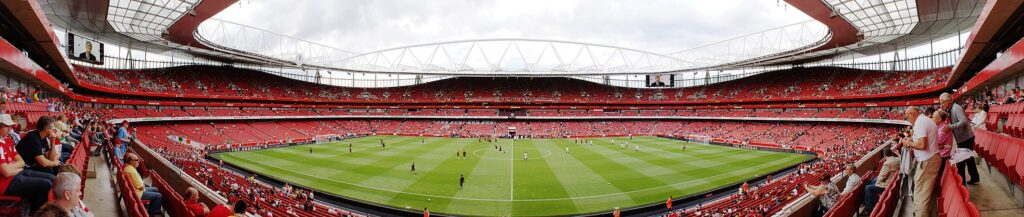
Emirates Stadium is Arsenal’s new home ground, which began to be used in the 2006-07 season. It is located in Holloway, in the London Borough of Islington, in the north of the city.
The stadium opened on 22 July 2006 and has a seating capacity of 60,432, making it the fourth largest football stadium in the UK, and the second-largest stadium in the Premier League after Old Trafford. It is also the third-largest stadium in London, after Wembley and Twickenham, which hosts rugby matches.
The stadium’s first official match took place on 19 August 2006, in a 1–1 draw with Aston Villa in the 2006–07 Premier League. The first goal was scored by Swedish defender Olof Mellberg.
Arsenal world rankings
Arsenal is at #6 in World Rankings.
Arsenal trophies
- Kent Senior Cup – 1889–90 (1)
- London Charity Cup – 1889–90 (1)
- London Challenge Cup – 1921–22, 1923–24, 1930–31, 1933–34, 1935–36, 1953–54, 1954–55, 1957–58, 1961–62, 1962–63, 1969–70 (11)
- London Senior Cup – 1890–91 (1)
- Inter-Cities Fairs Cup – 1969–70 (1)
- UEFA Cup Winners’ Cup – 1993–94 (1)
- FA Community Shield – 1930, 1931, 1933, 1934, 1938, 1948, 1953, 1991, 1998, 1999, 2002, 2004, 2014, 2015, 2017, 2020 (16)
- FA Cup – 1929–30, 1935–36, 1949–50, 1970–71, 1978–79, 1992–93, 1997–98, 2001–02, 2002–03, 2004–05, 2013–14, 2014–15, 2016-17, 2019-2020 (14)
- First Division (until 1992) and Premier League – 1930–31, 1932–33, 1933–34, 1934–35, 1937–38, 1947–48, 1952–53, 1970–71, 1988–89, 1990–91, 1997–98, 2001–02, 2003–04 (13)
- League Cup – 1986–87, 1992–93 (2)
- Mercantile Credit Centenary Trophy – 1988–89 (1)
- Southern Professional Floodlit Cup – 1958-59 (1)
Arsenal Main Rivals?
Tottenham Hotspur
Neighbors and rivals are the great rivalry of the City of London. The rivalry began when Arsenal moved from the east to the north of the city, playing at Highbury Stadium, next to Tottenham Hotspur Stadium. The first clash between the teams took place in 1887.
The rivalry intensified even more in the first decades of the following century, more precisely in 1919, right after the First World War, when Arsenal was invited to a place in the first division, occupying exactly the vacancy that would be Tottenham.
On 26 February 2012, Arsenal thrashed Tottenham 5-2 after losing 2-0.
Chelsea
Another local rival, but this one was expanded more recently, in the 2000s, mainly from the moment when Chelsea became one of the teams of the so-called English Big Four, after the arrival of millionaire Roman Abramovich.
It is also directly linked to the dispute over titles and players, such as Ashley Cole, who left Arsenal for Chelsea, which caused a great deal of controversy in England. Cole, who until then was an idol of the Gunners, signed with the Blues under harsh circumstances, and has since gone on to be branded as one of Arsenal’s most hated players.
The comments of Jose Mourinho, for many years Chelsea manager, who constantly attacked Arsene Wenger in press conferences and interviews in general, also promoted such rivalry.
On October 29, 2011, Arsenal applied a historic 5-3 over Chelsea at Stamford Bridge. In this match, the Dutch Robin van Persie had a great performance and scored three goals. Already on March 22, 2014, Arsenal suffered a historic rout at Stamford Bridge, as Chelsea won by 6-0, thus applying their biggest victory in the derby. In 2019, they played in the UEFA Europa League final, which Chelsea won 4-1. The following season, Arsenal and Chelsea played another FA Cup final, which ended in a 2-1 victory for Arsenal with two goals from Aubameyang, securing his 14th title.
Manchester United
Manchester United has been a rival for many decades, due to the fact that both clubs are recognized for their victorious and traditional histories in English football. In the period between 1996 and 2004, the Premier League was won by Arsenal or Manchester United, and from there, the teams developed an even greater rivalry in this competition and in other championships.
Against the Red Devils, there are several clashes marked by violence on the field, with dozens of expulsions throughout the matches. A key point of this rivalry was during the 2003–04 Premier League season. This season Arsenal were champions with a spectacular unbeaten record, without losing a single game during the entire championship and, during one of the games with Manchester United, a 0-0 draw at Old Trafford, in a game called “The Battle Trafford”, then Arsenal captain Patrick Vieira was sent off in the 80th minute, a fact that culminated in a great riot, and resulted in four yellow cards for each side.
On August 27, 2011, he suffered the biggest rout imposed in the classic between the teams. Playing at Old Trafford, Arsenal lost to Manchester United 8-2.
FAQs
Who is the captain of Arsenal for the 2025-26 season?
Martin Ødegaard is Arsenal’s captain for the 2025-26 season, leading the team with his vision, creativity, and composure.
What are the key features of the Arsenal 2025-26 home kit?
The home kit features a red and white design with a gothic “A” pattern, HEAT.RDY technology, and recycled materials for sustainability.
Which players left Arsenal before the 2025-26 season?
Notable departures include Kieran Tierney, Jorginho, Nuno Tavares, and Marquinhos, with 20 players released as contracts expired.
Conclusion
The Arsenal 2025-26 season promises to be a thrilling chapter in the club’s illustrious history. With a talented squad led by captain Martin Ødegaard, a visionary coach in Mikel Arteta, and the iconic Emirates Stadium as their fortress, the Gunners are poised for success. The new Adidas kits, blending tradition and innovation, symbolize Arsenal’s ambition to reclaim glory in the Premier League and beyond. As fans eagerly await the season’s kickoff, Arsenal’s blend of youth, experience, and heritage sets the stage for an exciting campaign.
Source: FootballArroyo.co.uk

One Comment